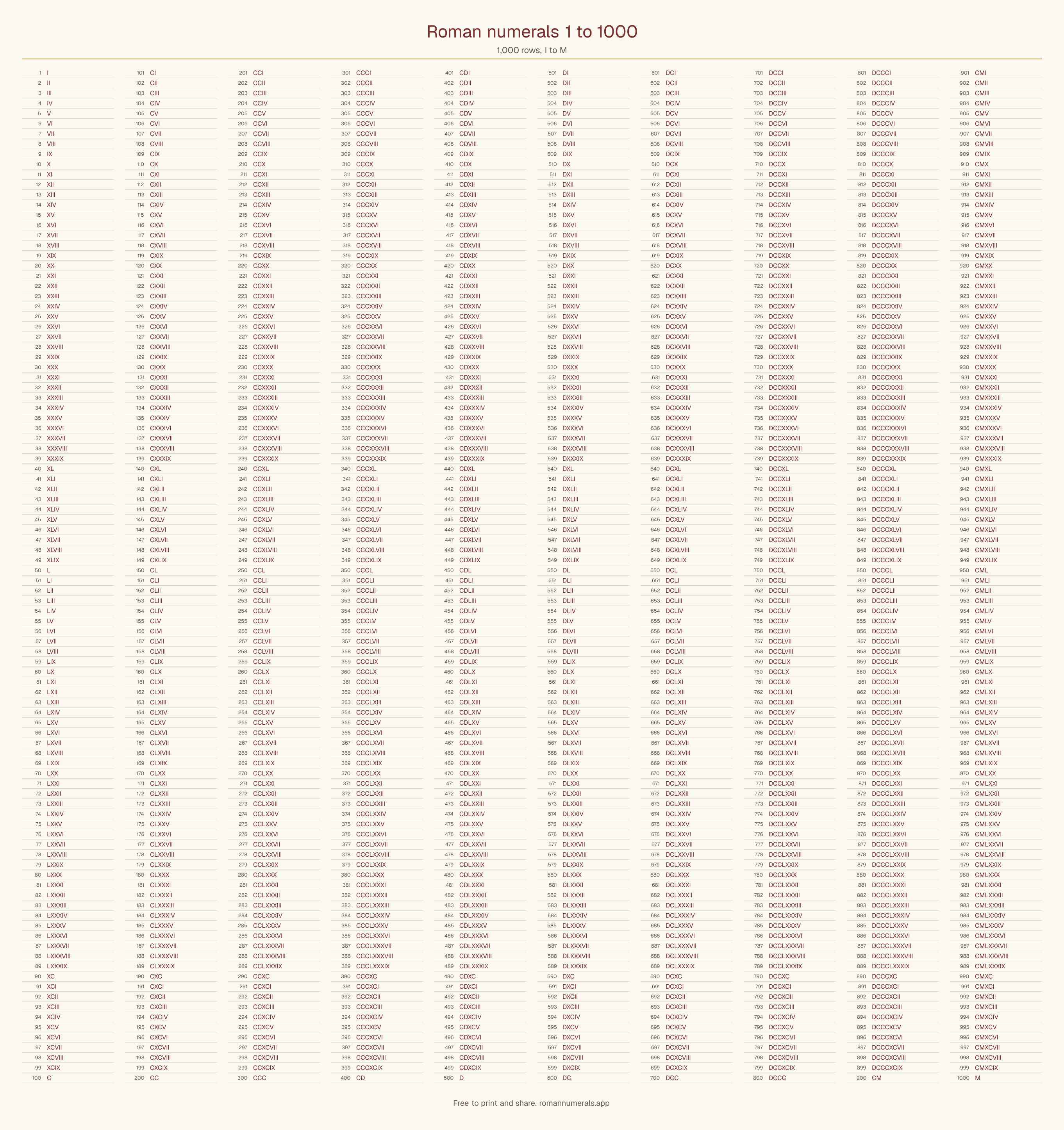
Roman numerals 1-1000 chart
All seven Roman symbols appear between 1 and 1000, which runs from I to M: I=1, V=5, X=10, L=50, C=100, D=500, M=1000. CM stands for 900.
1 in Roman numerals is I.
Numbering a list in CSS? list-style-type: upper-roman (or lower-roman) does it without typing the numerals.
- I1
- = 1
How this chart is checked: every row comes from the same conversion code as the converter, and an automated test runs that code over all 3,999 values, converting each one to a Roman numeral and back to the same number. The test also confirms that no numeral contains IIII, XXXX, CCCC, MMMM, VV, LL or DD, and that 20 known values match, among them 900 = CM, 999 = CMXCIX and 1000 = M.
1,000 rows, I to M.
How to use this chart
Each row pairs an ordinary number with its Roman numeral. Read the value on the left, then the numeral on the right. Type a number or a numeral into the find box to jump straight to its row, or narrow the chart to the subtractive forms or the multiples of ten. Numbers with their own page link to a full breakdown of how the numeral is built and where it is used.
From I to M in one chart
One to one thousand is the complete lower system, from a single stroke to M, the largest single Roman symbol. It adds the hundreds to everything the 1 to 100 chart already covers: C, then CC and CCC, the subtractive CD at four hundred, D for five hundred, DC through DCCC, the subtractive CM at nine hundred, and finally M. A three-figure numeral simply stacks a hundreds group, a tens group and a units group, read from the largest down.
Four hundred (CD) and nine hundred (CM) are the hundreds-place mirrors of forty and ninety. If you can read XL and XC, you already understand CD and CM: the same subtractive shape, one place value up. That symmetry is the reason the system scales so neatly.
Reading a three-part numeral
Take a value like 847. Break it into eight hundred (DCCC), forty (XL) and seven (VII), and you get DCCCXLVII. Every number in the hundreds works this way: find the hundreds, then the tens, then the units, write each group, and set them side by side. The chart lets you trace that pattern across a thousand rows, which is the fastest way to get comfortable with longer numerals.
This is also the range where numerals start to get long. Numbers built from repeated hundreds and tens, like 888 (DCCCLXXXVIII), stretch out because Roman numerals are additive and never compress the way Arabic digits do. That length is worth seeing before you engrave or tattoo one.
The full lookup, plus single pages
This chart is the master lookup for any value up to a thousand. Every row links to a full page for that number, with a breakdown of how the numeral is built and where it is used, so you can go from the table to the detail in one tap. Print the chart for a complete paper reference, or use the converter above for a value you just want to check quickly.
Frequently asked questions
What are the Roman numerals from 1 to 1000?
The Roman numerals from 1 to 1000 run from I (1) to M (1000), and the chart on this page lists all 1,000 of them in order. Every one is built from seven letters, I, V, X, L, C, D and M, with IV, IX, XL, XC, CD and CM covering the fours and nines.
Can I download a Roman numerals 1 to 1000 chart as PDF?
Yes, the Roman numerals 1 to 1000 chart is a free PDF download of five A4 pages, with no sign-up. The same 1,000 rows also come as a PNG image and as a CSV file for spreadsheets.
How do you write numbers up to 1000 in Roman numerals?
To write a number up to 1000 in Roman numerals, split it into hundreds, tens and units and write each part in turn. For example, 847 is DCCC (800) + XL (40) + VII (7), which gives DCCCXLVII.
Is there a list of Roman numbers 1 to 1000?
Yes, this page is a complete list of Roman numbers 1 to 1000, one row per number from I to M. Roman numbers is another common name for Roman numerals, and the values are the same.
What is one to a thousand in Roman numerals?
One to a thousand in Roman numerals is I to M: one is I and a thousand is M. The value just before M, 999, is CMXCIX, and the longest numeral in the range is 888, DCCCLXXXVIII, at twelve letters.
Can I download the Roman numbers 1-1000 chart as an image?
Yes, the Roman numerals 1 to 1000 chart is a free PNG image, laid out in ten columns of one hundred rows. It suits a slide or a printout; to sort or filter the values, take the CSV file instead.