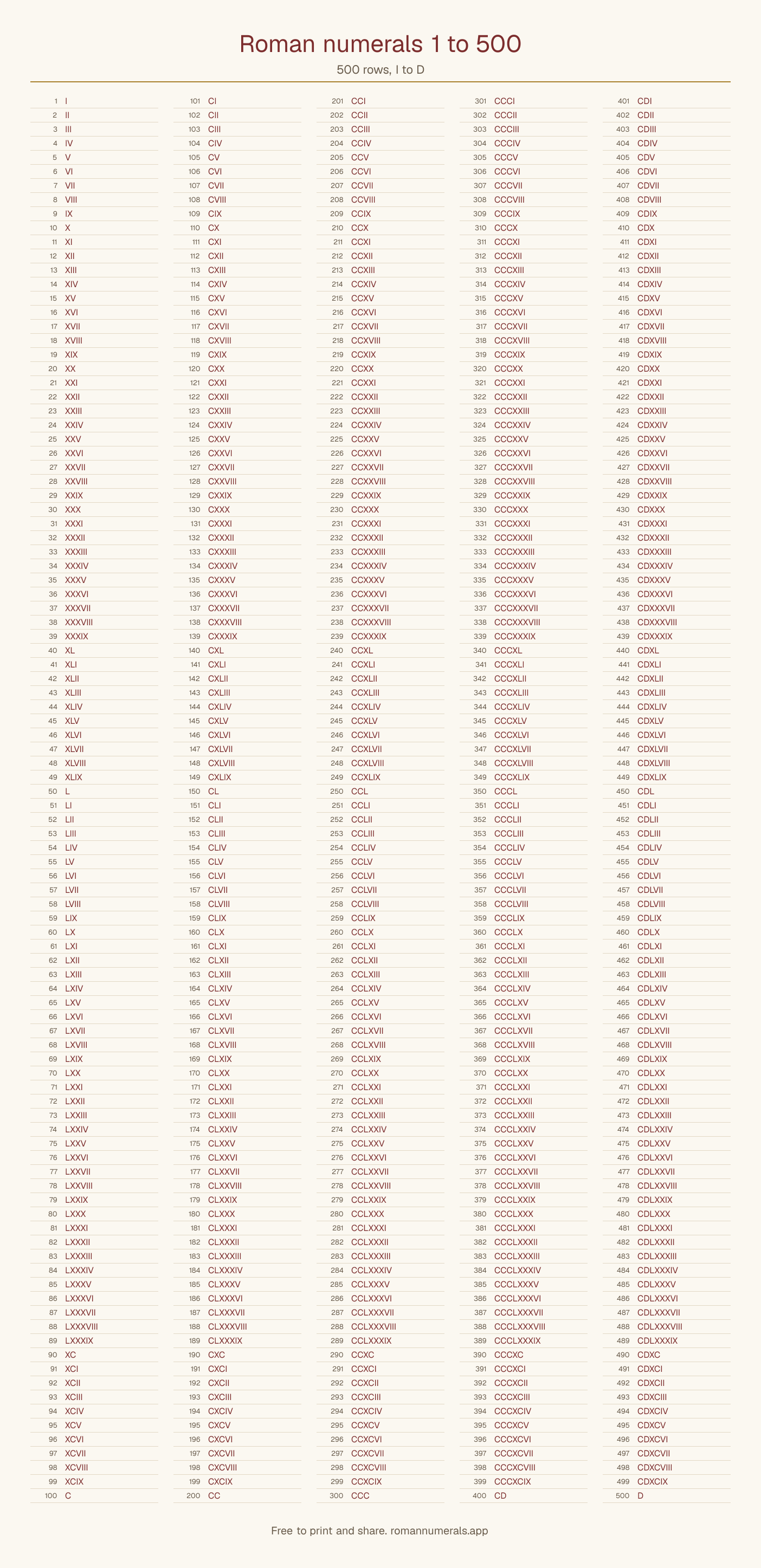
Roman numerals 1-500 chart
The numbers 1 to 500 end at D and use six Roman symbols, I=1, V=5, X=10, L=50, C=100 and D=500, with CD written for 400.
1 in Roman numerals is I.
Numbering a list in CSS? list-style-type: upper-roman (or lower-roman) does it without typing the numerals.
- I1
- = 1
How this chart is checked: every row comes from the same conversion code as the converter, and an automated test runs that code over all 3,999 values, converting each one to a Roman numeral and back to the same number. The test also confirms that no numeral contains IIII, XXXX, CCCC, MMMM, VV, LL or DD, and that 20 known values match, among them 99 = XCIX, 400 = CD and 499 = CDXCIX.
500 rows, I to D.
How to use this chart
Each row pairs an ordinary number with its Roman numeral. Read the value on the left, then the numeral on the right. Type a number or a numeral into the find box to jump straight to its row, or narrow the chart to the subtractive forms or the multiples of ten. Numbers with their own page link to a full breakdown of how the numeral is built and where it is used.
Into the hundreds: 1 to 500
One to five hundred is the range where the hundreds join the game. Everything below C you may already know from the shorter charts; from there the pattern repeats one place value up. C is one hundred, CC and CCC stack it, CD is the subtractive four hundred, and D closes the range as the single letter for five hundred, exactly the way V closes the first five.
That mirroring is the deep structure of the system. The units run I to V to IX, the tens run X to L to XC, and the hundreds run C to D to CM. Learn one column of that table and you have learned them all, because the same five shapes repeat with bigger letters.
CD, the four hundred people misread
The one value in this range that regularly goes wrong is four hundred. It is CD, one hundred before five hundred, the same subtraction as IV and XL a place value up. Written CCCC it would break the three-repeat limit, so the standard system never does. If you can already explain why forty is XL, you can explain CD to anyone.
Reading a three-figure numeral out of this chart is a matter of slicing it into groups: CDLXVII is CD (400) + LX (60) + VII (7), so 467. The chart lets you check any slice against its row instantly.
Where the 1 to 500 range turns up
This is the working range of page numbering in long books, of numbered articles in treaties and constitutions, and of anniversary and jubilee styling up to the odd quincentenary. It also covers every Super Bowl and WrestleMania that will be played for centuries. Keep the chart open next to the converter above: read a row here, type the value there, and the numeral is confirmed before you rely on it.
Frequently asked questions
How do you read a Roman numerals 1 to 500 chart?
Read the number in the first column and its Roman numeral beside it: this chart runs from 1 (I) to 500 (D).
Is this Roman numeral chart free to print?
Yes, this chart is free to print and to download as a PDF, a PNG image or a CSV file.
What is 500 in Roman numerals?
500 in Roman numerals is D.