Roman numerals 1-20 chart
From I to XX, the numbers one to twenty use the same three letters, I=1, V=5 and X=10, with IV, IX, XIV and XIX as the subtractive forms.
Find and filter
20 rows, I to XX.
| Number | Roman numeral | How it adds up |
|---|---|---|
| 1 | I | I = 1 |
| 2 | II | II = 2 |
| 3 | III | III = 3 |
| 4 | IV | IV = 4 |
| 5 | V | V = 5 |
| 6 | VI | VI = 6 |
| 7 | VII | VII = 7 |
| 8 | VIII | VIII = 8 |
| 9 | IX | IX = 9 |
| 10 | X | X = 10 |
| 11 | XI | X + I = 10 + 1 |
| 12 | XII | X + II = 10 + 2 |
| 13 | XIII | X + III = 10 + 3 |
| 14 | XIV | X + IV = 10 + 4 |
| 15 | XV | X + V = 10 + 5 |
| 16 | XVI | X + VI = 10 + 6 |
| 17 | XVII | X + VII = 10 + 7 |
| 18 | XVIII | X + VIII = 10 + 8 |
| 19 | XIX | X + IX = 10 + 9 |
| 20 | XX | XX = 20 |
Convert any number
20 in Roman numerals is XX.
Numbering a list in CSS? list-style-type: upper-roman (or lower-roman) does it without typing the numerals.
- X10+
- X10
- = 20
How this chart is checked: every row comes from the same conversion code as the converter, and an automated test runs that code over all 3,999 values, converting each one to a Roman numeral and back to the same number. The test also confirms that no numeral contains IIII, XXXX, CCCC, MMMM, VV, LL or DD, and that 20 known values match, among them 4 = IV, 9 = IX and 14 = XIV.
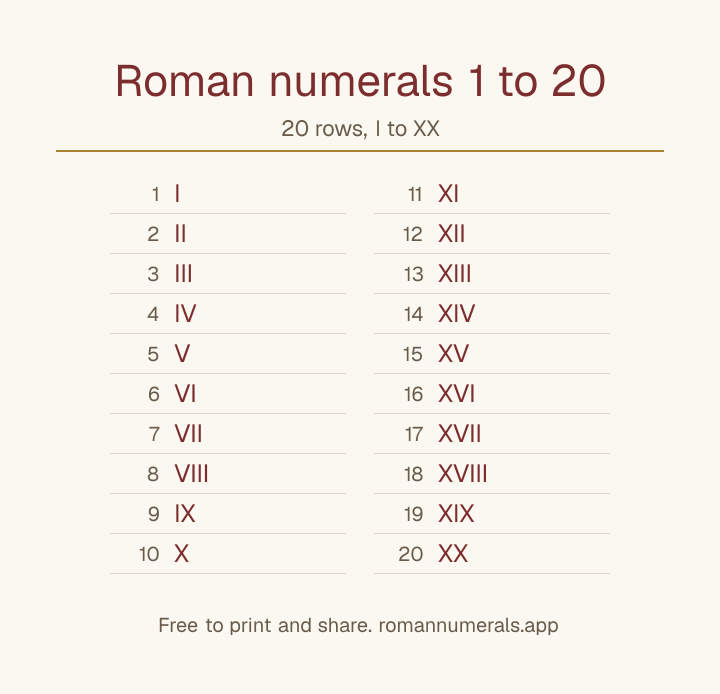
How to use this chart
Each row pairs an ordinary number with its Roman numeral. Read the value on the left, then the numeral on the right. Type a number or a numeral into the find box to jump straight to its row, or narrow the chart to the subtractive forms or the multiples of ten. Numbers with their own page link to a full breakdown of how the numeral is built and where it is used.
Past ten: how the teens are built
One to twenty carries you through the first full cycle of the tens. Eleven to nineteen are just X followed by the one-to-nine numerals you already know: XI, XII, XIII, then XIV with its subtractive four, up through XIX with its subtractive nine. Twenty is XX, two tens side by side. There is no new symbol to learn here, only the pattern of a ten on the left with a unit built on the right.
XII is worth singling out, because it is the number at the top of a clock face and the count of months, hours and zodiac signs. XVIII shows up as a milestone-birthday numeral, and XXI, just past this range, is the coming-of-age one. Seeing the teens laid out in a column makes the repeating shape obvious in a way a single lookup never does.
The subtractive pairs to watch
Two values in the teens use subtraction: XIV (fourteen) and XIX (nineteen). Both follow the same rule as IV and IX in the first ten, so once you have those, the teens hold no surprises. Everything else in this range is purely additive, read straight across from the largest symbol to the smallest.
A common mistake is to write fourteen as XIIII or nineteen as XVIIII by stacking strokes. The chart shows the correct forms plainly, which is exactly why a printed reference beats guessing: you can check the shape against the row before you commit it to ink or paper.
A handy classroom range
One to twenty is a favourite teaching range because it is long enough to show the repeating pattern of tens and units, but short enough to fit on a single card. It covers the numbers most children need first: dates up to the twentieth, list items, and the hours of a clock. Use the live converter above to quiz yourself, then print the chart for the wall.
Frequently asked questions
How do you read a Roman numerals 1 to 20 chart?
Read the number in the first column and its Roman numeral beside it: this chart runs from 1 (I) to 20 (XX).
Is this Roman numeral chart free to print?
Yes, this chart is free to print and to download as a PNG image or a CSV file.
What is 20 in Roman numerals?
20 in Roman numerals is XX.